
Master Mahjong Scoring in 10 Easy Steps
Mahjong scoring can seem overwhelming with its complex point systems and regional variations. Many players enjoy the game but struggle to keep track of their scores, leading to confusion and diminished enjoyment. At TheMahjong.com, we've simplified the process so you can focus on the fun while still appreciating the depth that scoring brings to this ancient game.
Understanding Mahjong Scoring Basics
Mahjong scoring is the method used to calculate points earned during gameplay, determining who wins and by how much. A "point" represents a unit of value that players exchange based on their hand compositions and winning conditions.
While Chinese, Hong Kong, and American mahjong each have distinct scoring systems, they all follow similar principles of rewarding strategic tile combinations and special patterns. Understanding scoring is crucial as it drives strategic decisions throughout the game - knowing which hands are worth pursuing can be the difference between a modest win and a game-changing score.
Key terminology you'll encounter includes:
- Melds: Combinations of tiles like pongs, kongs, and chows
- Fan: A scoring element that acts as a multiplier
- Base points: The foundational value of a hand before multipliers
- Honor tiles: Special tiles (dragons and winds) that offer bonus points
- Concealed vs. exposed: Whether tile combinations were visible to opponents
Building The Foundation With Sets And Pairs
A winning mahjong hand typically consists of four sets (melds) and one pair, totaling 14 tiles. How you form these sets significantly impacts your score, with some combinations worth substantially more than others.
Pong Mahjong and Other Melds
The basic building blocks of scoring include:
- Pongs: Three identical tiles (e.g., three 5 of bamboo) worth more points when concealed
- Chows: Three consecutive tiles of the same suit (e.g., 4-5-6 of dots), generally worth fewer points
- Kongs: Four identical tiles, which earn bonus points and allow drawing an extra tile
- Concealed Kongs: Four identical tiles collected without revealing them until declaring a kong
Each meld type contributes differently to your final score:
- Exposed pong: 2 points
- Concealed pong: 4 points
- Exposed kong: 8 points
- Concealed kong: 16 points
- Chow: Generally 0 points in most scoring systems but necessary for hand composition
For beginners looking to practice recognizing these patterns, our Stage 2 Free Mahjong offers an excellent opportunity to familiarize yourself with the various melds.
The Role Of A Pair
The pair (two identical tiles) completes your hand and can significantly boost your score when it consists of valuable tiles:
- Dragon pairs (red, green, or white dragons) earn bonus points
- Seat wind pairs (matching your position at the table) provide additional points
- Round wind pairs (matching the current prevailing wind) also add to your score
A pair of dragons that also matches your seat or round wind creates particularly valuable scoring opportunities. While regular numbered pairs typically don't add points, they're essential for completing the hand structure.
Counting Base Points
Base points form the foundation of your score before any multipliers are applied. Calculating these accurately is crucial for proper scoring.
1. Identify Basic Meld Scores
Begin by assigning point values to each meld in your winning hand:
- Pong of simple tiles (numbers 2-8): 2 points (exposed), 4 points (concealed)
- Pong of terminal tiles (1 or 9): 4 points (exposed), 8 points (concealed)
- Pong of honor tiles (winds or dragons): 4 points (exposed), 8 points (concealed)
- Kong of simple tiles: 8 points (exposed), 16 points (concealed)
- Kong of terminal or honor tiles: 16 points (exposed), 32 points (concealed)
2. Include Any Honor Tile Bonuses
Honor tiles bring additional value to your hand:
- Dragon tiles (red, green, white): 2 points each
- Player's seat wind: 2 points each
- Round wind: 2 points each
- Tile that serves both as seat and round wind: 4 points each
3. Check Concealed Or Exposed Melds
The visibility of your melds affects your score:
- Concealed melds (formed without taking discarded tiles) are worth twice as much as exposed melds
- A fully concealed hand (all melds formed from your draws) often qualifies for a significant multiplier
- Self-drawn winning tile (drawn from the wall rather than claimed from a discard) typically earns an additional multiplier
Doubling With Fans Or Multipliers
Fans (or doubles) can exponentially increase a hand's value, transforming a modest score into a massive one.
1. Confirm Specific Situations That Trigger Doubles
Common situations that qualify for doubling include:
- All pung hand (no chows)
- Pure suit hand (tiles from only one suit plus honors)
- Fully concealed hand (no exposed melds)
- Self-drawn win (winning with a tile drawn from the wall)
- Winning on the last tile from the wall
- No honor tiles (all numbered tiles)
2. Apply the Correct Number of Fans
The final score calculation often follows this formula: Base Points × 2^(number of fans)
For example, a hand with 8 base points and 3 fans would score: 8 × 2³ = 8 × 8 = 64 points
This multiplier system explains why experienced players often aim for specific hand patterns that qualify for multiple fans rather than simply maximizing base points.
Special Tiles and Limit Hands
Some exceptional combinations can yield extremely high scores, sometimes reaching the maximum allowed by rules.
1. Flowers, Seasons, and Bonus Tiles
Flower and season tiles add bonus points without counting toward the 14-tile hand requirement:
- Each matching flower/season (corresponding to your seat position): 2 points
- Complete set of flowers or seasons: additional 4 points
- These tiles are drawn and set aside immediately, with replacement tiles drawn
Our Full Vision 3 Free Mahjong mode provides an excellent way to practice identifying these special tiles and their scoring implications.
2. Rare Hands Like 13 Mahjong
Certain special pattern hands receive maximum points regardless of other factors:
- hirteen Orphans (one of each honor, 1 and 9 of each suit, plus one duplicate)
- Seven Pairs (seven distinct pairs instead of the standard four sets and one pair)
- Four Kongs (extremely rare hand with four kong melds)
- All Honors (a hand composed entirely of honor tiles)
These hands often score the maximum allowable points due to their rarity and difficulty.
How Points Are Transferred and Settled
After a winning hand is declared, players exchange points according to specific rules.
1. Winner's Payout
The winner typically collects points from all other players:
- In most rules, all players pay the winner the full value of the hand
- If the winning tile was self-drawn, players often pay double
- The dealer (East) pays and receives double in many variants
2. Settlement Among Non-Winners
In some mahjong variants, non-winners may also exchange points based on:
- Penalties for specific tiles left in hand
- Ready status (whether they were one tile away from winning)
- Special circumstances like chombo (invalid winning declaration)
Mahjong Scoring Chart For Quick Reference
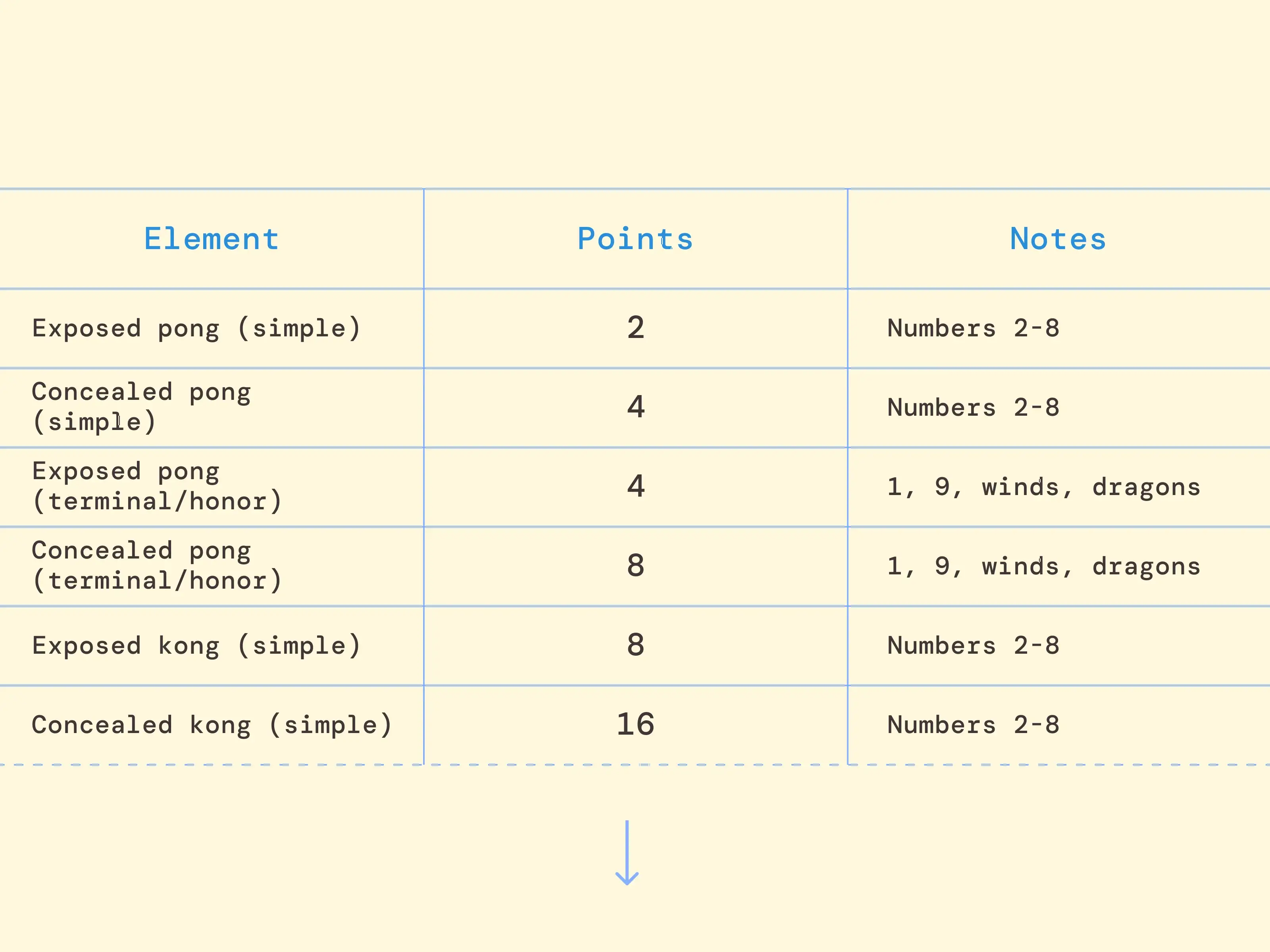
Melds and pairs
Exposed pong (simple)
- Points: 2
- Notes: Numbers 2–8
Concealed pong (simple)
- Points: 4
- Notes: Numbers 2–8
Exposed pong (terminal/honor)
- Points: 4
- Notes: 1, 9, winds, dragons
Concealed pong (terminal/honor)
- Points: 8
- Notes: 1, 9, winds, dragons
Exposed kong (simple)
- Points: 8
- Notes: Numbers 2–8
Concealed kong (simple)
- Points: 16
- Notes: Numbers 2–8
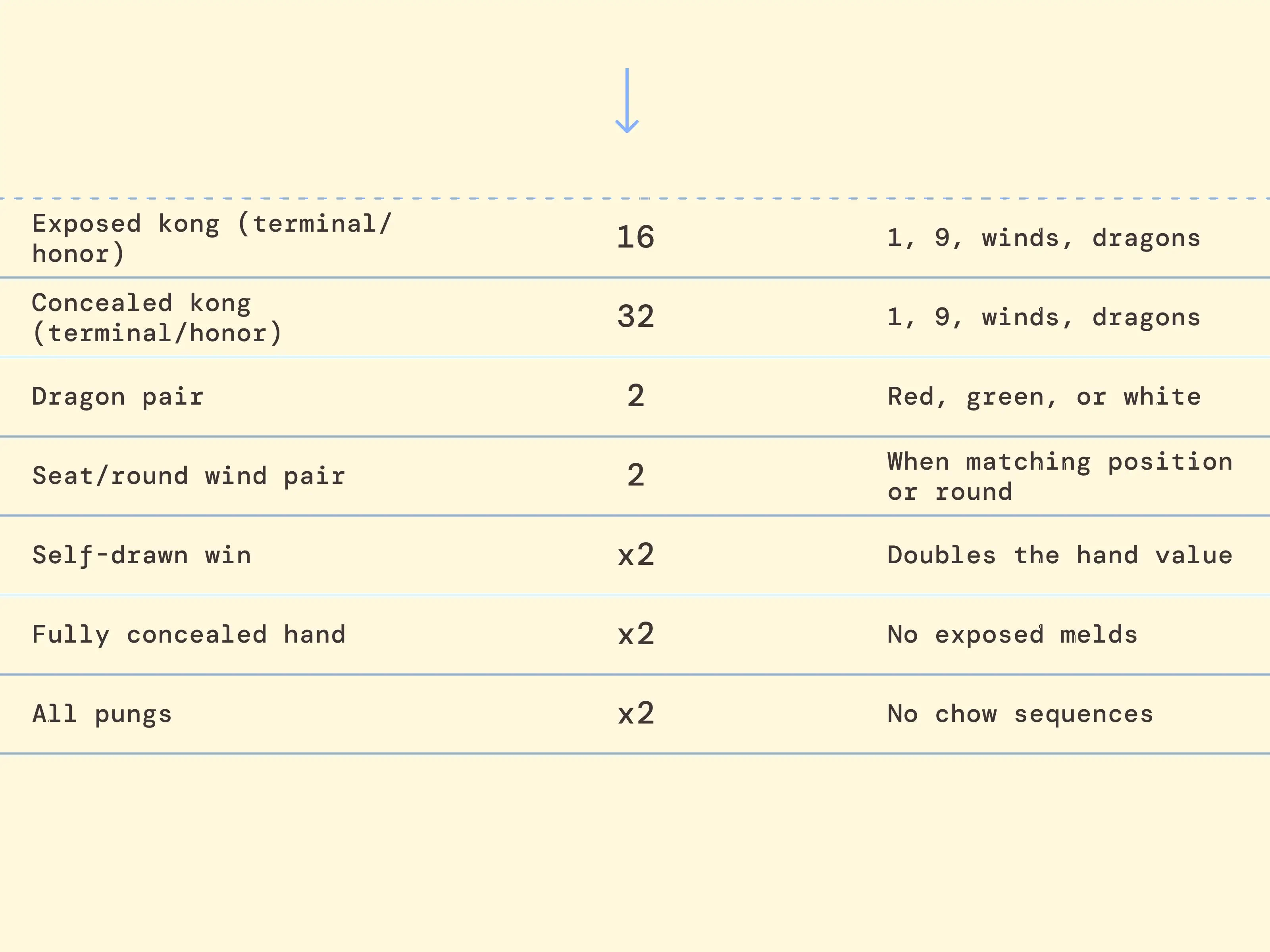
Exposed kong (terminal/honor)
- Points: 16
- Notes: 1, 9, winds, dragons
Concealed kong (terminal/honor)
- Points: 32
- Notes: 1, 9, winds, dragons
Dragon pair
- Points: 2
- Notes: Red, green, or white
Hand conditions and bonuses
Seat/round wind pair
- Points: 2
- Notes: When matching position or round
Self-drawn win
- Multiplier: ×2
- Notes: Doubles the hand value
Fully concealed hand
- Multiplier: ×2
- Notes: No exposed melds
All pungs
- Multiplier: ×2
- Notes: No chow sequences
Differences In Chinese Hong Kong And American Mahjong Rules
Each mahjong variant has its own scoring approach, which affects strategy and gameplay.
1. Chinese Mahjong Scoring Rules
Chinese Official rules use a minimum point requirement system:
- Minimum 8 points required to win
- Points come from combinations of patterns (fans)
- No limit to maximum points (though some tournaments cap at 64)
- Greater emphasis on concealed melds
2. Canton Mahjong Variations
Hong Kong (Canton) scoring differs in several important ways:
- No minimum point requirement
- Uses base points with multipliers
- Often includes payments between non-winners
- More generous scoring for certain combinations
3. American Mah Jongg Scoring
American Mah Jongg stands apart with its unique approach:
- Score based on hand patterns listed on annually-updated cards
- Fixed-value hands rather than calculated points
- Winners receive payments based on hand difficulty
- Doubles awarded for special winning conditions
Strategy Tips For Higher Scores
Strategic play can significantly increase your scores over time.
1. Maximize Pungs And Kongs
To build high-scoring hands:
- Prioritize pongs over chows when possible
- Declare kongs when they don't reveal your hand strategy
- Consider terminal and honor tiles for their higher point values
- Balance the risk of revealing your strategy against the reward of higher scores
2. Seek High-Fan Combinations
Aim for valuable pattern combinations:
- Pure suit hands generally score higher than mixed suits
- All pung hands often qualify for multiple doubles
- Dragon pongs and your seat/round wind pongs offer excellent value
- Recognize when to abandon a high-point strategy that's unlikely to complete
Join The Mahjong Community
Mastering mahjong scoring enhances your appreciation of this fascinating game's depth and strategic elements. Regular practice helps solidify scoring concepts, making calculations second nature during gameplay.
At TheMahjong.com, you can practice these scoring principles with our free online mahjong games. Our platform automatically calculates scores while showing the breakdown, helping you learn as you play. Connect with other mahjong enthusiasts, refine your strategies, and experience the joy of this ancient game in a modern, accessible format.
FAQs About Online And House Rule Scoring
How do I track scores when playing mahjong online?
Most online mahjong platforms automatically calculate and display scores after each hand. The system tracks base points, multipliers, and special bonuses, showing a detailed breakdown of how the final score was determined. This automated scoring helps players learn the system while focusing on strategy rather than manual calculations.
What are the most common house rule modifications for mahjong scoring?
Common house rule modifications include adjusting minimum point requirements, changing multiplier values for specific hands, adding bonus points for certain tile combinations, and simplifying complex scoring calculations. Many groups also modify payment structures, such as having only the discarder pay the winner rather than all players, making the game more accessible for casual play.
How do scoring rules differ between competitive and casual mahjong games?
Competitive mahjong follows standardized scoring systems with strict minimum point requirements and precise calculations. Casual games often simplify scoring by using rounded values, eliminating minimum requirements, or adopting fixed-value hands. Tournament play typically enforces maximum point limits and penalties for errors, while casual games prioritize enjoyment over strict adherence to complex rules.
Why do mahjong scoring systems vary so much between regions?
Regional variations developed as mahjong spread across different cultures over centuries. Each region adapted the game to local preferences, creating distinct scoring philosophies—Chinese rules emphasize pattern complexity, Hong Kong rules favor faster gameplay with generous scoring, and American rules use standardized hand cards. These differences reflect cultural approaches to game balance and strategic depth.
What is the easiest mahjong scoring system for beginners to learn?
American Mahjong is often considered easiest for beginners because it uses fixed-value hands listed on reference cards rather than complex calculations. Players simply match their tiles to card patterns and receive predetermined scores. Alternatively, simplified Chinese scoring with basic fan combinations offers straightforward point calculations while maintaining traditional gameplay elements.
Other Mahjong News

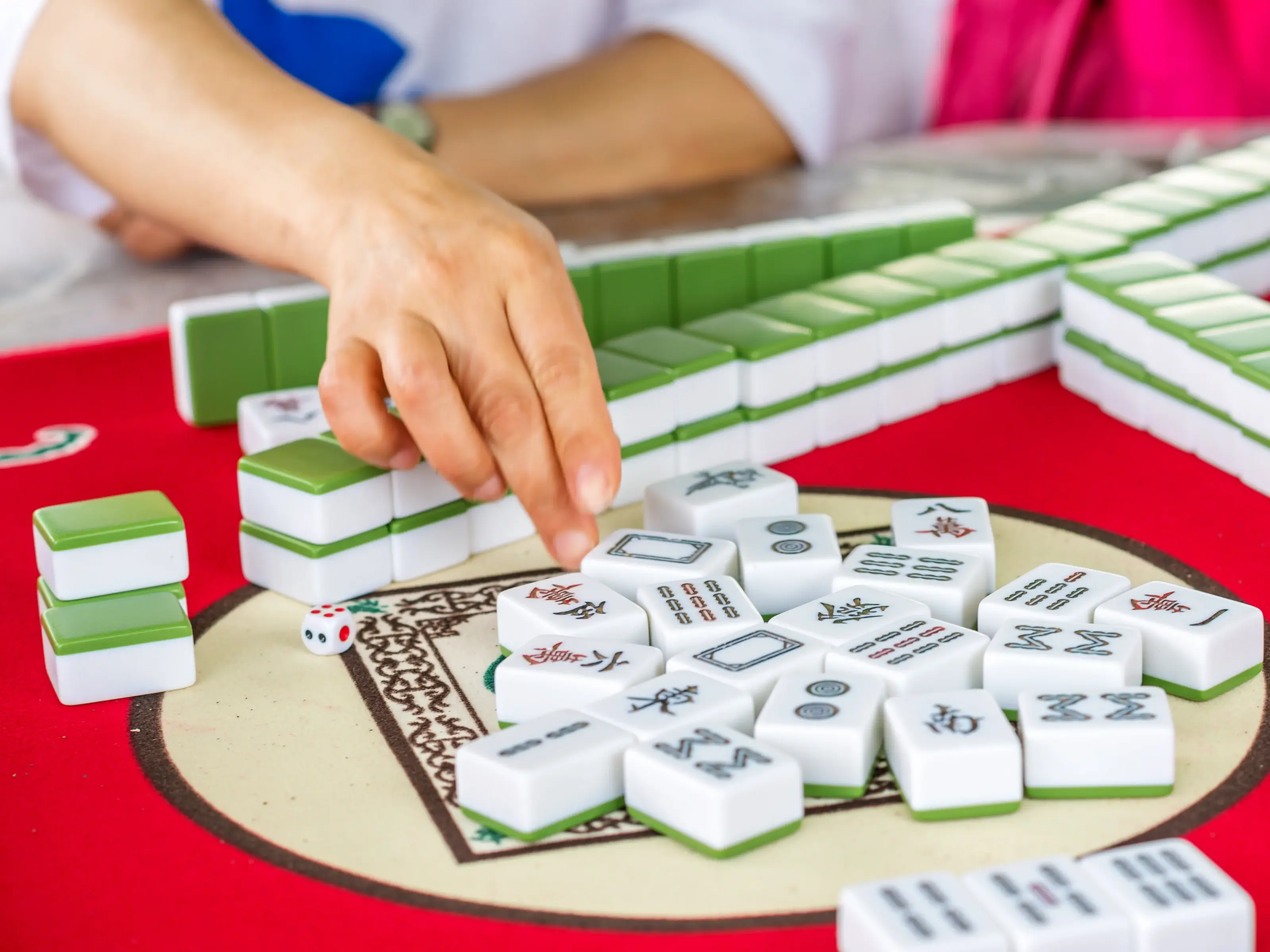
Try out the Mahjong gameplay practices on TheMahjong.com
Playing Mahjong at TheMahjong.com offers not just an interesting and exciting pastime, but also an excellent way to improve cognitive skills. Here, you can refine your logical thinking, planning, and visual perception. We invite you to discover this unique world of Mahjong Solitaire and dive into an exciting adventure at TheMahjong.com!